
Execution Leverage Series: Role Architecture
Founders do not get overwhelmed because they are doing too much.
Founders get overwhelmed because they still own too many outcomes.
Revenue. Activation. Delivery. Retention. Operations. Cash. The founder becomes the owner of every meaningful result, and that is what creates overload. Not the work, but the ownership load.
This week is about Role Architecture and the shift from hiring for tasks to hiring for outcomes.
Role Architecture is the practice of designing roles around the outcome they own, not the tasks they perform. It is how founders transition from doing everything to creating clear ownership structures that allow the company to scale. A role exists to produce a result. If a role does not have a defined outcome, it becomes a list of activities instead of a source of leverage.
Most founders try to relieve pressure by asking what tasks they can delegate. Tasks are not the bottleneck. Tasks are symptoms. If the founder still owns the outcome, delegation does not create leverage. The founder remains the decision maker, the safety net, and the bottleneck. This is why hiring often does not reduce stress. Nothing changed at the level of accountability.
The high-leverage question is not “What can someone do for me.”
The question is “Which outcome should someone else fully own so I no longer carry it.”
This shift moves the founder out of reactive execution and into strategic leadership.
Outcome Ownership vs Task Delegation:
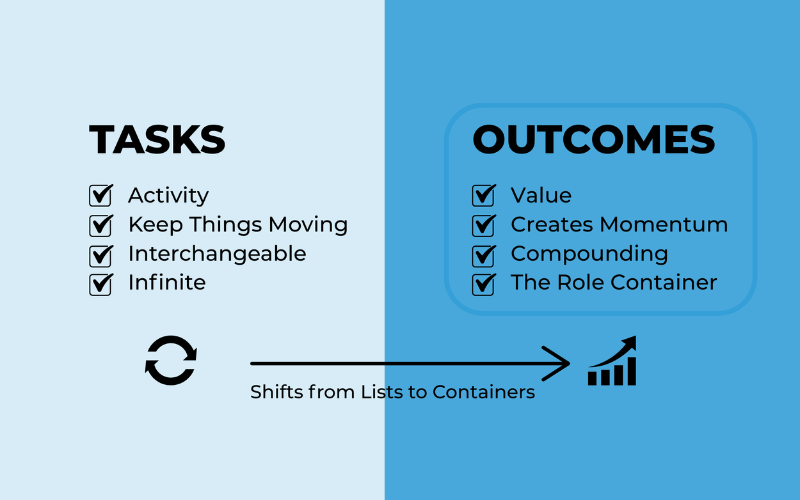
1. Tasks equal activity. Tasks keep things moving. They are interchangeable and infinite.
2. Outcomes equal value. Outcomes create momentum. Outcomes compound.
3. Roles equal outcome containers. A role exists to own a result so the founder does not have to.
If a role cannot answer the sentence “This role exists to produce [specific outcome],” then it is not a role. It is a list. Lists do not scale. Outcome owners do.
Examples:
Marketing Manager
Write content
Run campaigns
Manage social channels
Actual outcome: Own pipeline creation and demand velocity.
Head of Operations
Build processes
Manage tools
Support the team
Actual outcome: Own cycle time reduction, margin protection, and customer activation.
Hiring for tasks builds helpers. Hiring for outcomes builds leaders. Leaders create leverage.
A simple five-minute exercise:
Write down the top three outcomes you are still holding that you should not be.
Examples: revenue operations, customer activation, delivery quality.
Then ask: Who should own this instead. What would success look like without me in the middle.
Founders do not need more hours. They need fewer outcomes sitting on their shoulders.
Delegating tasks will never scale a company. Delegating outcome ownership changes everything.
When someone else owns a result, decisions speed up, execution becomes clearer, accountability stabilizes, founder stress decreases, and thinking time returns.
This is execution leverage. This is Role Architecture. This is the point where the company stops depending on the founder for survival and starts compounding.
You do not hire tasks. You hire outcomes. And once you make that shift, momentum becomes inevitable.
Author: Laura Lirette

Decision Leverage for Seed-Stage Founders
Summary Most founders think they have a time problem. They actually have a decision problem. When every path depends on you choosing, approving, or reviewing something, your entire company becomes bottlenecked by your brain. [...]

You Don’t Hire Tasks. You Hire Outcomes.
Execution Leverage Series: Role Architecture Founders do not get overwhelmed because they are doing too much. Founders get overwhelmed because they still own too many outcomes. Revenue. Activation. Delivery. Retention. Operations. Cash. The founder [...]

Operational Leverage for Seed-Stage Founders
Introduction Last week, we explored how leverage is created by assets that pay you back over time. This week, we focus on how founders can apply leverage inside execution through Operational Leverage. Operational Leverage [...]
